
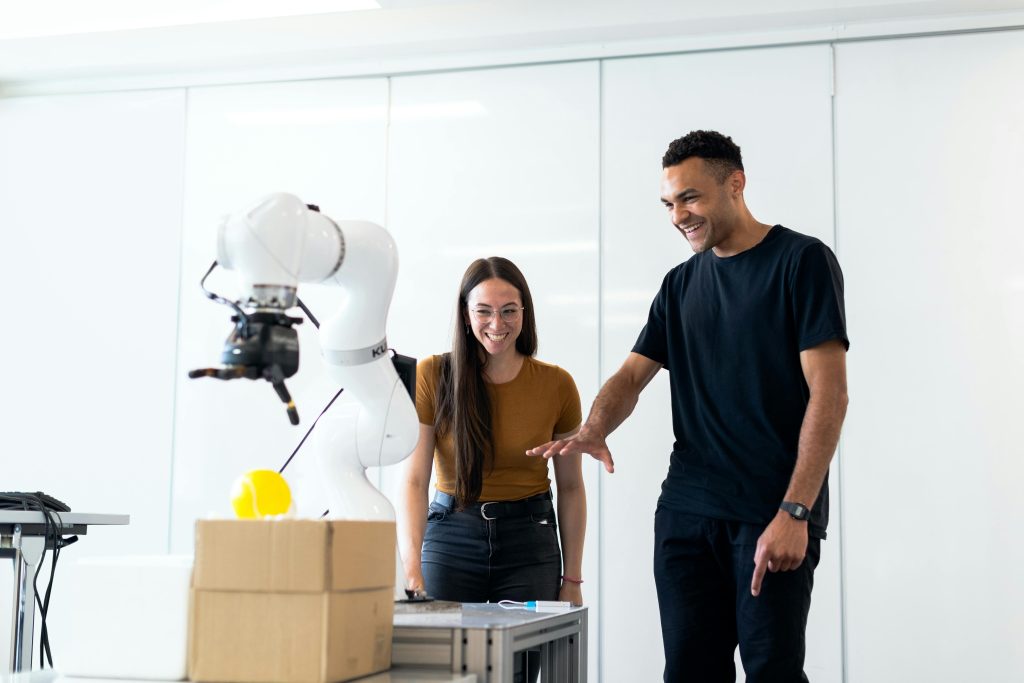
In the movie I-Robot, a detective played by Will Smith is intensely robophobic. The detective is worried that AI will take his job and also has concerns about AI’s ability to make sound ethical decisions. In the end, he is saved by the AI he feared.
Two years ago, in May 2022, data from the Bureau of Labor Statistics revealed that employers posted a record-high number of job openings. The record high meant that there were two job openings for every person who was unemployed. That picture has shifted since then, but is AI to blame?
AI is undoubtedly transforming the world of work. From automation to enabling new forms of creativity, AI is reshaping industries and redefining the way we work. Every industry is integrating AI-driven tools. AI algorithms are diagnosing diseases with remarkable accuracy. Bank lenders are using AI to detect fraudulent activity in real-time, and farmers are using AI to analyze soil health and weather patterns.
Decades ago, when machines were being used in mass manufacturing, the new machines eased manual labor and increased human productivity. The robotics of yesteryear revolutionized manufacturing, but today’s AI is revolutionizing how we think and move through life.
AI can now work in ways that save time, money, and creative energy, but it also raises concerns about job displacement. Routine and manual jobs are most vulnerable, while roles requiring creativity, critical thinking, and emotional intelligence are less likely to experience mass displacement.
AI is changing the landscape of work, making it harder to navigate fields that are rapidly evolving as AI progresses in its capabilities. We are officially in a new era in the world of work, and the Fourth Industrial Revolution is here.
According to a report by McKinsey, nearly a million jobs could be automated by 2030. However, as AI replaces old jobs, it will create new job opportunities and industries. Job roles for AI trainers, AI ethicists, robot technicians, and other related positions will grow.
To thrive in the future job market, continuous up-skilling and lifelong learning will be essential for career sustainability. People committed to increasing their creativity, critical thinking, and interpersonal skills are less likely to be replaced. And even some jobs that AI is currently replacing may find that the need for human touch still exists.
A good example is Walmart and other big box retailer’s use of AI-powered self-checkout systems. Some retailers have closed cash registers in many stores, pushing customers toward self-checkout and allowing AI to oversee the transaction. This has significantly reduced the need for human workers. However, the company has also scaled back, discerning that many customers prefer human interaction.
As industries and sectors continue to leverage AI, the future of work and employment opportunities will shift favorably towards workers who are focused on determining how to work with AI instead of against it. The future of AI involves collaborative intelligence, where humans and AI work in tandem. AI shouldn’t be viewed as a job destroyer but as a way to enhance the potential of human work.